Industry News
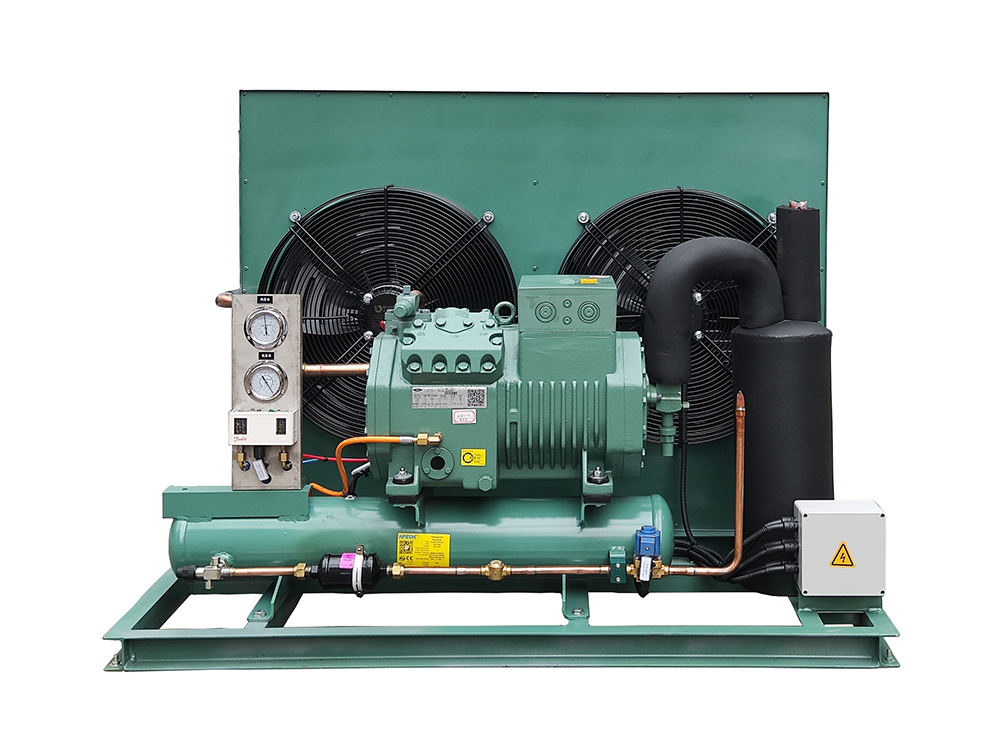
BITZER Piston Air-Cooled Unit: Reliable Condensing Power for Stable Refrigeration Systems
In modern refrigeration engineering, the condensing unit is not just a supporting component—it is the system’s energy transformation center. Among various configurations, the BITZER piston air-cooled unit has become a widely adopted solution for cold storage, food processing, logistics refrigeration, and industrial cooling applications due to its strong stability and proven compressor technology.
Instead of focusing only on cooling capacity, engineers increasingly evaluate how a condensing unit behaves under long-term load variation. In this context, BITZER piston-based air-cooled systems are valued for their consistent compression performance, structural integration, and predictable operating characteristics.
Why the Condensing Unit Defines System Stability
In a complete refrigeration loop, the condensing unit performs two critical functions:
- Compressing refrigerant vapor into high-pressure gas
- Releasing heat through air-cooled condensation
- Maintaining pressure balance across the entire system
While evaporators define heat absorption, the condensing unit determines how smoothly the system can “reset” the refrigeration cycle.
A BITZER piston air-cooled unit is often chosen because it provides:
- Stable compression under varying load conditions
- Reliable heat rejection through air-cooled condenser design
- Strong adaptability for medium and low-temperature applications
- Predictable pressure control behavior during continuous operation
This stability directly influences system efficiency and operational consistency.
The Role of the Piston Compressor in System Behavior
At the core of the unit is the BITZER semi-hermetic piston compressor, a design widely used in industrial refrigeration for its mechanical robustness and long service life.
Unlike more complex variable systems, piston compression provides a clear and controlled operating pattern:
- Each compression cycle follows a fixed mechanical process
- Load changes are handled through staged or controlled operation
- Pressure fluctuations remain within predictable ranges
- Mechanical structure supports long continuous operation
This makes the system especially suitable for environments where reliability matters more than aggressive performance optimization.
Air-Cooled Condensation: Simplicity with Functional Strength
The air-cooled condenser is another defining feature of this system. Instead of relying on water circuits or external cooling towers, heat is directly rejected into ambient air through finned heat exchangers and axial fans.
This design provides several operational advantages:
- Simplified system layout with fewer external dependencies
- Easier installation in outdoor environments
- Reduced water system maintenance requirements
- Direct and continuous heat rejection process
- Strong adaptability to decentralized refrigeration sites
While ambient temperature affects efficiency, the simplicity of air cooling makes the system highly practical for many real-world installations.
System Integration Matters More Than Individual Components
A BITZER piston air-cooled unit is typically built as a fully integrated condensing system, combining compressor, condenser, receiver, and control components into a unified structure.
This integration is important because refrigeration performance depends on interaction between components, not isolated efficiency.
In system operation, integration ensures:
- Coordinated pressure and temperature behavior
- Reduced installation complexity and piping errors
- Faster commissioning in field applications
- More stable long-term operational behavior
Instead of tuning individual parts, engineers manage a complete and synchronized refrigeration module.
Operating Conditions and Real-World Applications
BITZER piston air-cooled units are widely used in environments where refrigeration must remain stable over long operating cycles.
Typical application areas include:
- Cold storage warehouses
- Food processing and preservation facilities
- Logistics and distribution temperature control
- Industrial manufacturing cooling systems
- Commercial refrigeration infrastructure
These environments often involve fluctuating load conditions, frequent start-stop cycles, and long operational hours—all of which require a stable condensing system.
Reliability Under Continuous Load Conditions
One of the key engineering values of piston-based systems is predictable mechanical behavior under continuous operation.
In real-world conditions, reliability is influenced by:
- Compressor mechanical stability
- Heat rejection consistency
- Pressure balance across system cycles
- Resistance to operational fatigue over time
BITZER piston technology is widely recognized for maintaining consistent performance under these long-duty conditions, making it suitable for critical refrigeration systems where downtime is costly.
Maintenance Perspective and Lifecycle Stability
From a maintenance standpoint, air-cooled piston condensing units offer a relatively straightforward service structure.
Key advantages include:
- Accessible component layout for servicing
- Standardized compressor maintenance procedures
- No external water system maintenance requirements
- Predictable wear patterns over time
- Long operational lifecycle under proper conditions
This reduces both operational complexity and long-term maintenance planning uncertainty.
Conclusion
The BITZER piston air-cooled unit is not simply a refrigeration product—it is a stable condensing platform that defines how a cooling system behaves under real operational conditions.
Its value lies in mechanical reliability, predictable compression behavior, and straightforward air-cooled heat rejection. Together, these characteristics make it a trusted solution for industrial and commercial refrigeration systems that prioritize stability, continuity, and long-term operational dependability.
In modern refrigeration design, performance is no longer measured only by cooling power—but by how consistently the entire system maintains balance over time. The condensing unit plays a central role in that equation.